
300 Day Hikes To Take With Your Dog Before He Tires You Out
“They look like they are having the time of their lives.”If you hike with dogs chances are you have heard sentiments like that from other trail users when they see your happy trail dogs. Dogs are happy on any trail but they become espe- cially excited on new trails. New scents to sniff. New sounds to hear. New sights to see.Every year an estimated 15 million people travel with their dogs. But our best trail companions are not always wel- come where we most want to go. National parks ban dogs from trails for the most part and more than half of America’s 1,500+ public beaches don’t allow dogs. But let’s not dwell on the negative - our dogs will not allow it.Are these the 300 best hikes in America you can take with your dog? While there are many, many hikes described in this book that are on “best lists” and “must-do lists” and “bucket lists” the goal here is to emphasize the rich variety of hiking experiences that await you and your dog. There are canine hikes dusted in history, canine hikes to unusual destinations, and canine hikes that are notable just because. There is a mix of leg-stretchers and hikes requiring a full day on the trail.All the day hikes are in the continental United States that can be reached by driving. The selected hikes are spread throughout regions so that you are never far from a special outing with your dog.
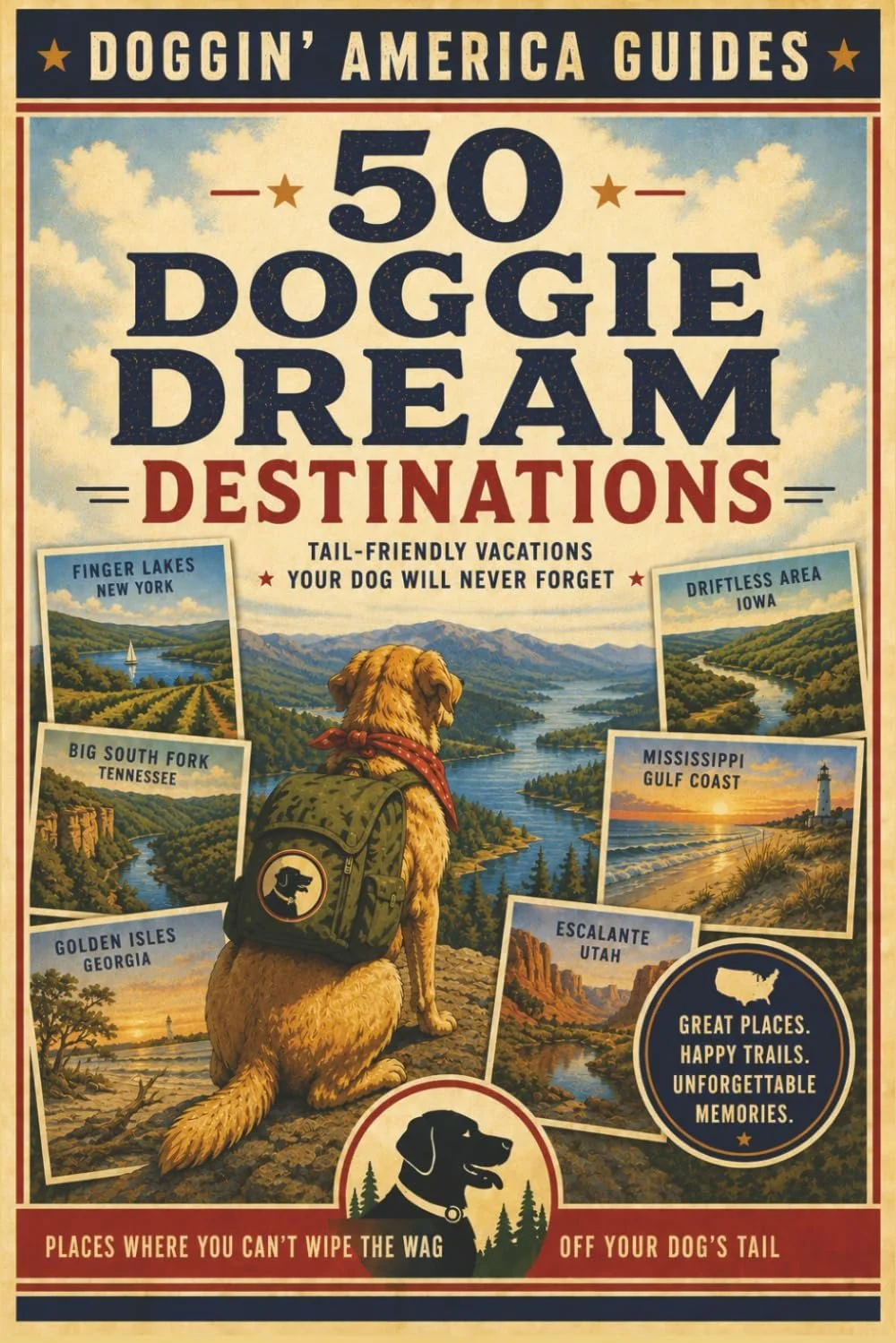
50 Doggie Dream Destinations
From hikewithyourdog.com, your go-to source for finding tail-friendly trails since 2001, comes the ultimate guide to adventure vacations with your dog - tail-tested and approved 50 Doggie Dream Destinations.
Every year an estimated 15 million people travel with their dogs. In recent years, mercifully, it has become much easier to do so with more and more lodging facilities becoming pet-friendly. But what happens when you actually want to leave the hotel room with your dog?
Our national parks are notoriously unfriendly to dogs. Of the more than 1,500 public beaches in the United States more than half don’t allow dogs at all and most of the rest have some sort of restrictions. But there are rewarding outdoor vacations to be had out there that can include your dog. Even center around your dog.
This book is not about traveling with your dog to tiny, fenced-in dog parks or disappearing compeltely into the wilderness; it is about places you want to see, and taking your dog to share your fun. A good number of destinations will not be showing up on lists of “best vacation spots” any time soon. After all, these are destaintions your dog would pick - maybe a little less civilized, certainly a lot less crowded.
So, plan that next vacation to include your dog, grab that leash and let's get going!
70 Pubic Gardens To Visit With Your Dog
Every year some 300 million people visit America’s public gardens. That is the same of people who visit America’s national parks.
Public gardens and national parks have another thing in common - the vast majority of those visits take place without dogs.
But all is not lost for dog owners who want to share their time in these beautiful spaces with their best trail companions.
Most of the first generation of America’s gardens were developed privately on vast estates based on European-style designs. Many are now open to the public, operated with rich endowments and long-standing prohibitions against dogs in place. Large cities often followed the same model in creating public garden spaces for their residents.
In the 1970s the country’s environmental consciousness was stirred by individuals and groups pointing out that America’s natural habitats were fast disappearing. Grass roots organizations sprang up to start gardens in smaller communities lacking the financial resources available to the heritage gardens. In pursuit of fundraising and membership drives many could not afford to overlook a potential source of money - the half of the population who own dogs.
So well-behaved dogs began to be welcomed in gardens. And lo and behold, the world did not end. This book, then, is a guide to America’s public gardens that welcome dogs. Most welcome dogs without restriction. Some have carved out regular visiting hours for dogs in the gardens, striking a balance between those who desire to enjoy the gardens dog-free and those who want to walk the paths with their dog. These are included in the guide.
Even some of the gardens listed above take down the “No Dogs” signs for special fundraisers during the year. The Atlanta Botanic Garden, for instance, hosts an annual holiday-themed Reindog Parade where owners can bring their dogs to walk the grounds and compete for prizes.
Who knows, in time this book may become completely unnecessary.
How To Hike With Dogs At Our National Parks
Dogs and parks. Wed two of our favorite things together and you have the makings of a perfect day, right? Except at America’s national parks. Save for a few exceptions, dogs are never allowed on national park trails and rarely permitted beyond a campground or picnic area. There is an old saying that goes, “Start explaining and you’ve lost the argument.” The National Park Service goes to great lengths to explain their reasons for banning dogs outside of vehicles. Dogs endanger wildlife. Dogs interfere with people’s enjoyment of the park. Dogs ruin the pristine environment. Dogs can introduce diseases that could decimate wild populations. Some parks cite the fact that just the scent of dogs will make prey animals frantic (at least that will keep the jittery critters out of campgrounds and picnics where apparently their wellbeing is not as big a concern). Some park officials go so far as to imply that they are doing dog owners a favor by keeping dogs out of the woods since they may become prey themselves. One park’s regulations read thusly: “There is a strong possibility that your pet could become prey for a bear, coyote, owl, or other predator.” What is a “strong possibility?” Better than 50%? 20%? Really? Any talk of the probability of a leashed dog on a trail being eaten by a wild animal that goes beyond “vanishingly small probability” is absurd. Tellingly, the national parks in Canada - which also receive millions of visitors each year and also protect wildlife - allow dogs on their trails almost without exception. And in the United States the prohibition against dogs on national park trails is not a universal edict. Individual parks are allowed to make their own rules regarding dogs. A handful have decided to allow dogs on the trails, the chance of man's best friend becoming some other animal’s dinner be damned. Some have even become more lenient in recent years. Petrified Forest National Park used to allow dogs only on a few nature trails. Now the park declares: “Petrified Forest is a very pet friendly national park! Please take your furry friends on trails, even backpacking in the wilderness area.” This is not a book about whether rules regarding dogs in national parks are right or wrong. It is about how dog owners - given the current restrictive playing field - can experience our national parks, take along their best trail companions, and still have their dream vacation. For each park, if dogs are not allowed on the trails, a nearby substitute is identified and described (dogs are usually welcome in national forests, for example. The burden on people and wildlife caused by dogs and a patronizing concern for a dog’s well-being apparently cause less government worry in those woods). Only those national parks which can be reached by automobile are included. So with that in mind - grab a leash and hit the trail!
National Forest: Always A Trail Dog's First Choice
When it comes to hiking with our dogs, the word “national” carries a special magic. It speaks of belonging, of shared inheritance — of the open spaces that define who we are as a people. Yet many dog owners, eager to lace up their boots and leash up their companions, instinctively look first to national parks. And who can blame them? The parks are America’s crown jewels — Yosemite’s granite cathedrals, Yellowstone’s geysers, the Great Smoky Mountains’ misted folds.
But there’s a quiet truth worth celebrating: while the National Parks protect our country’s icons, it is the National Forests that truly welcome us — and our four-legged friends — with open arms.
The 63 National Parks were created to safeguard exceptional places, and that mission comes with necessary restrictions. Dogs are usually limited to paved areas, overlooks, and campgrounds, barred from most trails to protect fragile ecosystems and wary wildlife. For a hiker traveling with a canine companion, that can mean peering longingly down paths that say no dogs allowed.
In contrast, the 154 National Forests and 20 National Grasslands — a staggering 193 million acres of public land — were founded under a different ideal: multiple use. They are living landscapes where recreation, conservation, and community all coexist. Here, dogs aren’t bystanders — they’re participants.
National Forests offer a mosaic of experiences no park can match. You’ll find 9,000 miles of scenic byways, 150,000 miles of trails, 4,400 miles of wild and scenic rivers, and over 5,000 campgrounds scattered across every state. Many of these trails see a fraction of the traffic of nearby parks. That solitude means fewer crowds, fewer cars, and more moments of pure connection — the kind where your dog pauses to look back, ears pricked, as if to ask, “Isn’t this ours?”
America’s National Parks will always be our sacred preserves, but the National Forests are our everyday wilderness — vast, welcoming, and alive. They are the beating green heart of the nation, a place where humans and hounds alike can rediscover that simple, ancient truth: we belong to the land, and it belongs to us.
So next time the leash jingles by the door and the tail starts to wag, skip the crowds and the “no dogs allowed” signs. Head for the nearest stretch of green on the map that says National Forest. - we'll tell you about the history of the forest and must-see highlights. We'll recommend five "pawsitively must-do" trails and pick out options if you only have an hour or two to visit.
State Park Pass - America's Best Idea For Dog Lovers
National parks are America’s best idea - state parks are a dog’s best idea. National
parks may have been called “America’s best idea,” but for dog lovers, they often
feel like the nation’s biggest tease - epic trails and grand vistas, yet dogs are rests-
ricted to paved pull-outs and campgrounds in all but a handful of parks. Enter
state parks: America’s second best idea, and arguably the best idea of all for those
who hike with four paws in tow. With hundreds of hidden waterfalls, forest loops,
seaside trails, and historic landscapes that welcome dogs as fellow adventurers,
state parks offer an affordable, wide-open alternative to crowded national parks.
That’s the promise of the State Park Pass—a roadmap to the trails, cabins, and
quirky treasures where America’s natural wonders aren’t just admired from the
parking lot, but experienced side-by-side with your best friend.
State parks are America’s democratic idea - affordable, welcoming, and
dog-friendly. They preserve local pride and natural beauty while inviting everyday
use, from a Saturday morning hike to a week-long family vacation. The National
Park Service, created in 1916, saw its role as protecting landscapes and sites of
national wonder. In the early days few qualified; even today there are only some
five dozen. Over the years another 400 or so national monuments, historic sites
and seashores have been placed with the park service.
Today there are thousands of state parks across 18 million acres - a patchwork
quilt of lakes, beaches, forests, and historic sites with roughly one billion visits an-
nually - far surpassing the attendance at national parks. It all began with Niagara
Falls in 1885. America’s greatest natural attraction of the 19th century was be-
coming tawdry with sideshow attractions and industrial development so New York
created the Niagara Falls State Reservation, the nation’s first true state park.
By the onset of the Great Depression in the 1930s there were still relatively few
state parks. Many states had no state park system at all and the parks that did exist
were largely undeveloped. Franklin Roosevelt created the Civilian Conservation
Corps (CCC) to put young men to work and between 1933 and 1942 more than
700 parks were constructed in 40 states. Since the federal government was footing
the bill, these new natural playgrounds could easily have been absorbed into the
National Park Service system. But the NPS wanted no part of running these “pic-
nic parks.” Washington’s logic was: wonder and grandeur belong in the national
system; recreation belongs to the states.
And America’s dogs have been wagging their tails ever since.
Pick a state. Now go build your next doggie dream vacation around state parks.